Decentralized Cloud & Compute: Competing with AWS and Google Cloud
Knackroot
10/15/2025
Introduction
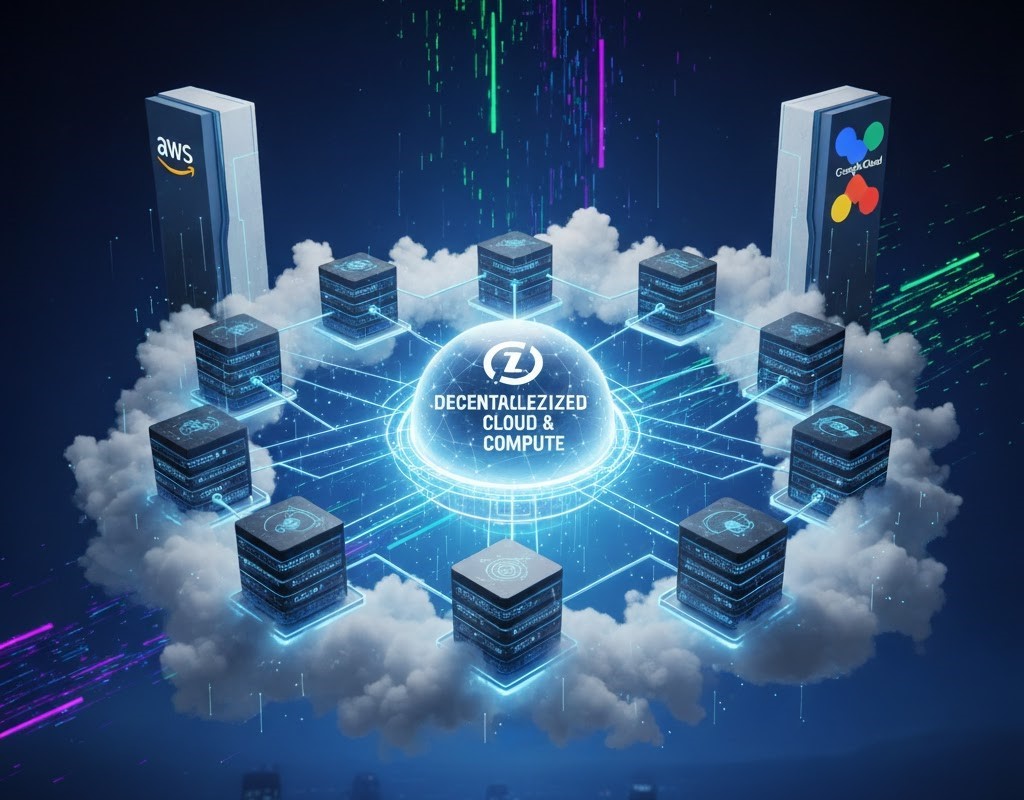
The cloud computing industry, long dominated by centralized providers like Amazon Web Services (AWS), Google Cloud, and Microsoft Azure, is witnessing a paradigm shift. Emerging decentralized cloud and compute platforms—built on blockchain and peer-to-peer (P2P) networks—are disrupting the status quo. By removing central points of control and enabling open participation, decentralized clouds aim to offer more affordable, secure, and censorship-resistant alternatives to traditional infrastructure providers.
“Decentralized cloud computing replaces corporate-owned data centers with global, user-owned infrastructure.”
What is Decentralized Cloud & Compute?
Decentralized Cloud and Compute refers to distributed computing and storage systems where individuals or organizations contribute their idle computational resources—such as CPU, GPU, or storage—to a blockchain-based marketplace. Instead of relying on a few tech giants, these networks leverage smart contracts to coordinate and pay contributors transparently. Projects like Filecoin, Akash Network, Arweave, and Render Network exemplify this movement, providing compute power, data storage, and content delivery through decentralized protocols.
Key Features
Decentralized cloud systems combine blockchain transparency with distributed resource efficiency, introducing key advantages over traditional providers:
Real-World Applications
Decentralized cloud and compute networks are already being applied in diverse industries, providing open, global alternatives to centralized infrastructure:
Challenges Ahead
Despite rapid innovation, decentralized cloud computing faces several challenges before achieving mainstream enterprise adoption:
The Road Ahead
The decentralized cloud market is growing rapidly, projected to reach billions in market capitalization by 2030. As Web3 adoption accelerates, demand for censorship-resistant and cost-effective compute infrastructure will rise sharply. Hybrid cloud models—combining decentralized networks with traditional cloud APIs—are expected to emerge as a practical bridge for enterprises. Innovations like proof-of-compute, ZK verifiable workloads, and tokenized resource markets will play key roles in scaling trustless cloud ecosystems.
Conclusion
Decentralized Cloud and Compute represent a fundamental reimagining of how the internet’s backbone operates. By democratizing access to compute and storage, blockchain-powered networks are eroding the monopolies of tech giants and empowering individuals to both consume and contribute infrastructure. While technical and regulatory challenges persist, the long-term trajectory points toward an open, distributed, and verifiable cloud economy—where users, not corporations, own the web’s computing power.
Want to learn more about Blockchain or AI?
Explore more blogs and stay updated with the latest in Web3, AI, and emerging technologies.
Read More Blogs