Building End-to-End AI Automation Pipelines: Tools + Best Practices
Knackroot
11/4/2025
Introduction
AI automation pipelines are becoming the backbone of modern business operations — seamlessly connecting data ingestion, model training, inference, and decision-making. Instead of using isolated AI models, organizations now build end-to-end workflows that automatically process data, trigger models, and deliver actionable outcomes with minimal human intervention. These pipelines allow teams to scale AI initiatives efficiently and ensure consistent, reliable outputs across departments.
“AI automation pipelines turn complex machine learning workflows into repeatable, scalable systems that run themselves.”
What is an AI Automation Pipeline?
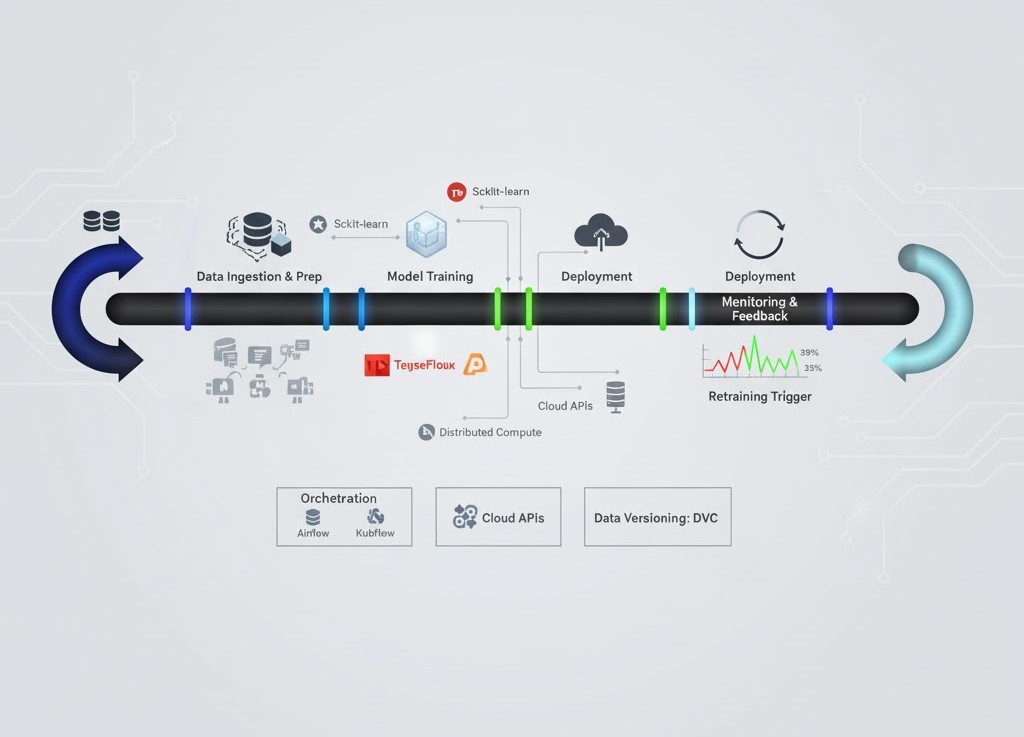
An AI automation pipeline is a structured workflow that automates the end-to-end process of applying machine learning and artificial intelligence — from raw data collection to decision execution. It typically includes data preprocessing, model selection, deployment, monitoring, and feedback loops. By integrating tools for orchestration and automation, organizations can drastically reduce manual overhead and accelerate innovation.
Core Components of an AI Automation Pipeline
A robust AI pipeline consists of multiple interconnected layers, each responsible for a specific part of the automation journey:
Real-World Applications
AI automation pipelines are being deployed across industries to eliminate bottlenecks and enable intelligent, self-operating systems:
Challenges and Considerations
While AI pipelines bring efficiency and scalability, they also introduce technical and organizational challenges:
The Future of AI Automation
AI automation is rapidly evolving with the rise of autonomous agents, self-healing workflows, and real-time model orchestration. Tools like LangGraph, n8n, and AutoGPT are enabling dynamic pipelines where AI not only executes tasks but also optimizes its own workflow. The future lies in 'AI-first infrastructure' — where automation systems are adaptive, collaborative, and capable of making decisions independently across complex enterprise environments.
Conclusion
Building end-to-end AI automation pipelines is no longer a futuristic goal — it’s a competitive necessity. By combining data orchestration, automated model management, and continuous monitoring, organizations can unlock unprecedented efficiency and innovation. While the journey demands robust architecture and governance, the payoff is transformative: intelligent systems that learn, adapt, and act autonomously — turning data into decisions at scale.
Want to learn more about Blockchain or AI?
Explore more blogs and stay updated with the latest in Web3, AI, and emerging technologies.
Read More Blogs