AI Agents in Real Estate: Lead Nurturing, Listing Creation & Valuation
Knackroot
12/8/2025
Introduction
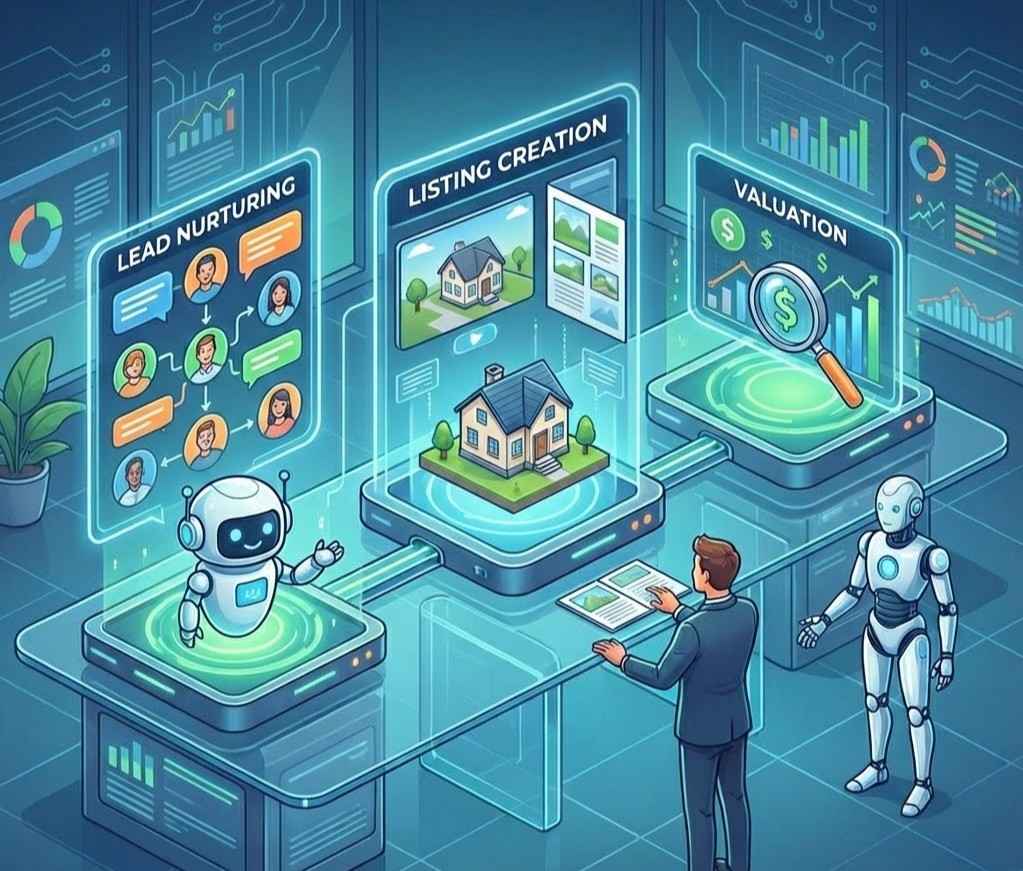
The real estate industry, traditionally reliant on manual processes and human expertise, is undergoing a profound transformation driven by AI agents. These intelligent systems are not just automating tasks—they're fundamentally reshaping how properties are marketed, leads are nurtured, and valuations are determined. From 24/7 lead engagement to instant property descriptions and data-driven pricing, AI agents are becoming indispensable tools for modern real estate professionals.
“AI agents don't replace real estate agents—they amplify their capabilities, allowing them to focus on what humans do best: building relationships and closing deals.”
The AI Revolution in Real Estate
Real estate has always been a relationship-driven business, but it's also data-intensive, time-consuming, and highly competitive. AI agents address these challenges by handling repetitive tasks with superhuman efficiency while providing insights that were previously impossible to obtain. Whether it's instantly responding to a midnight inquiry, generating compelling property descriptions in seconds, or analyzing thousands of comparable sales to determine optimal pricing, AI agents are transforming every stage of the real estate lifecycle. This shift allows agents and brokers to scale their operations, improve client experiences, and make data-driven decisions with unprecedented speed and accuracy.
Core Capabilities of AI Agents in Real Estate
AI agents bring a suite of powerful capabilities that address the most time-consuming and critical aspects of real estate operations:
Real-World Applications
AI agents are already delivering measurable results across the real estate ecosystem. Here's how different stakeholders are leveraging this technology:
Challenges and Considerations
While AI agents offer tremendous potential, successful implementation requires addressing several key challenges:
The Future of AI in Real Estate
The evolution of AI agents in real estate is accelerating. We're moving toward a future where AI doesn't just assist—it orchestrates entire transactions. Imagine AI agents that can: conduct virtual property tours using AR/VR, negotiate terms within predefined parameters, predict market shifts weeks in advance, and automatically adjust pricing strategies in real-time. Integration with IoT devices will enable AI to assess property conditions remotely, while blockchain integration will streamline title transfers and smart contracts. The next generation of AI agents will be multimodal—understanding images, videos, floor plans, and documents—providing even richer insights and automation. As these systems become more sophisticated, the role of human agents will evolve from task executors to strategic advisors, relationship builders, and deal architects, supported by AI that handles the heavy lifting of data analysis, communication, and process management.
Conclusion
AI agents are not replacing real estate professionals—they're empowering them to operate at a scale and efficiency previously impossible. By automating lead nurturing, streamlining listing creation, and providing data-driven valuations, AI agents free up valuable time for agents to focus on what truly matters: understanding client needs, building trust, and closing deals. As the technology matures and adoption increases, the competitive advantage will belong to those who embrace AI as a strategic partner. The future of real estate is hybrid—combining the irreplaceable human elements of empathy, negotiation, and relationship-building with the speed, scale, and insights that only AI can provide. For real estate professionals willing to adapt, AI agents represent not a threat, but an unprecedented opportunity to grow their business, serve clients better, and thrive in an increasingly competitive market.
Want to learn more about Blockchain or AI?
Explore more blogs and stay updated with the latest in Web3, AI, and emerging technologies.
Read More Blogs